10 Proven Benefits of Chess for Kids

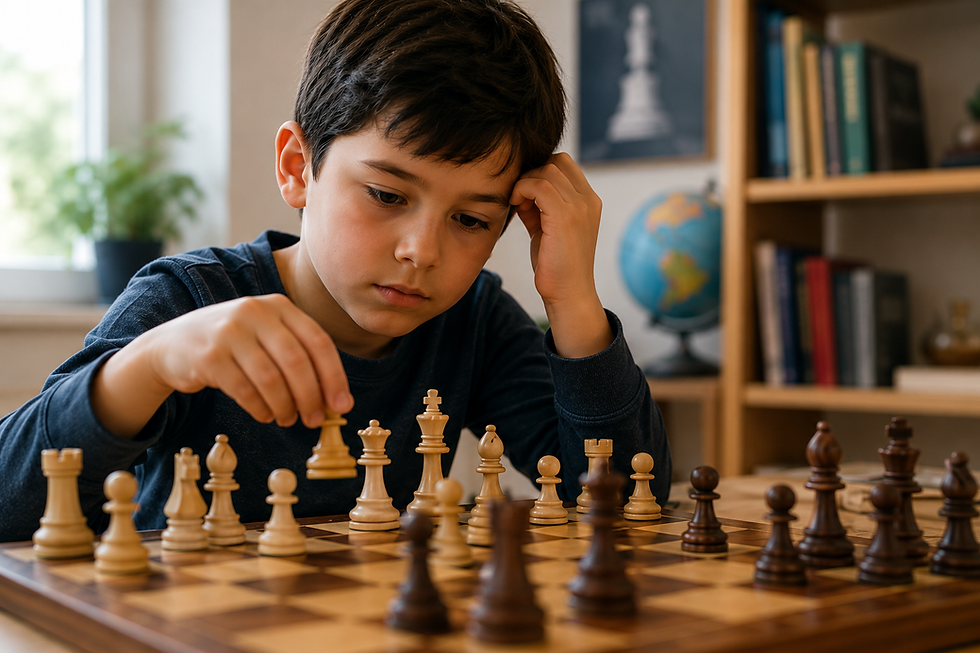
Every parent who has watched a child sit across a chessboard — brow furrowed, thinking hard — has sensed that something important is happening. That instinct is right. Chess is one of the most thoroughly studied cognitive activities in educational research, with decades of peer-reviewed evidence confirming what parents and coaches have long observed: the benefits of chess for kids extend far beyond the board, into the classroom, the therapist's office, and the rest of their lives.
This guide compiles the 10 most well-evidenced benefits, what the research actually says (without the hype), and how structured coaching at MM Chess Academy — rather than casual play alone — is what unlocks each benefit fully.
Key Statistics
167% better improvement with coached instruction vs self-study (Global Online Chess Learning Report 2026)
30+ countries use chess in official school curricula
$270M global chess education market in 2026, projected to reach $860M by 2035
The 10 Proven Benefits of Chess for Kids
BENEFIT 01 — Stronger Critical Thinking and Problem-Solving
A 2025 study in Frontiers in Psychology found preschoolers who played chess showed longer concentration during math and reading tasks. Every chess move is a micro-decision — assess, generate options, evaluate consequences, commit — repeated thousands of times until it becomes a transferable habit of mind.
At MM Chess Academy, coaches use the Chess Steps Method to introduce one new concept at a time — exactly the structured approach that builds this type of thinking most efficiently.
BENEFIT 02 — Improved Math and Reading Scores
A study by Ortiz-Pulido et al. (2019) found children who played chess once a week for 10 weeks performed significantly better in both math and reading than those who didn't. Chess's reliance on pattern recognition, logical sequencing, and spatial reasoning activates the same neural pathways as mathematical thinking.
BENEFIT 03 — Bilateral Brain Activation and Enhanced Memory
Brain imaging studies reviewed by Dynseo show chess simultaneously activates both the left hemisphere (logic) and right hemisphere (intuition, creativity). This bilateral activation is rare among childhood activities. Working memory demands of chess — holding positions, tracking piece activity — directly strengthen a child's ability to retain information in other subjects.
BENEFIT 04 — Longer Attention Span and Deeper Concentration
Chess demands sustained concentration from 15 minutes to several hours, training the brain's prefrontal cortex through repeated activation. Gliga & Flesner (2014) confirmed that chess players develop stronger neural connections responsible for sustained attention. The key variable is structure — casual apps have a smaller effect than lessons with a coach who sets time expectations and insists on deliberate thought.
BENEFIT 05 — Chess Helps Kids with ADHD
A landmark study by Aciego, Garcia & Betancort (2012) compared children who played chess against those who played soccer or basketball. The chess group showed better cognitive abilities — including attention, memory, concentration, and planning — and stronger coping capacities.
One of MM Chess's FIDE Masters holds a licensed psychology credential and specializes in working with children who have attention and emotional regulation challenges.

BENEFIT 06 — Emotional Resilience and How to Handle Losing
Research from Building Brains Together (2025) confirms chess enhances children's ability to manage emotions under pressure. Every loss was caused by a decision the player made — not a referee's call or bad luck. Children who learn to analyze losses rather than catastrophize them develop a growth mindset that carries into every area of life.
BENEFIT 07 — Creativity and Divergent Thinking
Dr. Robert Ferguson's 4-year longitudinal study found chess-playing children developed cognitive abilities — including creative and divergent thinking — superior to non-playing peers. The right-brain engagement documented in imaging studies is the neurological explanation: chess forces the brain to be simultaneously analytical and imaginative.
BENEFIT 08 — Self-Confidence and Intrinsic Motivation
A 2025 study in Frontiers in Psychology by Yuhan Ye found structured chess programs built measurable gains in self-confidence. Every rating point is earned, not given — chess provides one of the clearest connections between effort and outcome.
MM Chess's free monthly tournaments give students a low-stakes competitive environment where effort produces results, publicly and measurably.
BENEFIT 09 — Social Skills, Sportsmanship, and Community
The same Aciego et al. study found chess-playing children demonstrated superior socio-affective development compared to peers who played traditional sports. Shaking hands, respecting the clock, congratulating a winner — these rituals build social character that school curricula struggle to teach.
For Chicago families, our local club partnerships — including with the Chicago Chess Center — provide the in-person social chess experience alongside online coaching.
BENEFIT 10 — Long-Term Executive Function and Life Skills
The Global Online Chess Learning Report 2026 highlights that parents increasingly choose chess because it supports focus, planning, and logical thinking at a critical development stage. Chess develops every component of executive function — skills that transfer into every area of adult life.
Why Casual Play Captures Only a Fraction of These Benefits
Guided coaching produces a 167% better improvement than self-study alone (Global Online Chess Learning Report 2026). The cognitive benefits follow the same pattern. Casual play reinforces existing habits — including bad ones. Only a coach who notices the pattern and provides deliberate exercises to correct it will change how a child thinks.
This is why MM Chess Academy's curriculum is built around the internationally recognized Chess Steps Method — used by federations in over 30 countries — rather than open-ended game-playing sessions.
“When I was younger, the internet became just good enough to begin taking online lessons. We didn’t love our options in Columbus, Ohio, so my parents turned to a few chess forums online and found a great Russian-language coach in Serbia. Thanks to his lessons and tutoring, I became a master — and I learned firsthand the power of online chess lessons.”
— Misha Vilenchuk, Founder of MM Chess Academy, 3-time National Junior Champion

How to Give Your Child Access to All 10 Benefits
At MM Chess Academy, every coach holds a master-level FIDE title — browse the full coach roster. Sessions are 1-on-1, built on the Chess Steps Method, with homework between lessons. Monthly tournaments are free for all active students. After-school programs in 20+ Chicago schools serve local families. Online 1-on-1 coaching is available anywhere in the USA — no waitlist, no commute.
Frequently Asked Questions
1. What are the main benefits of chess for kids?
The 10 most well-evidenced benefits: critical thinking, improved math and reading scores, stronger working memory, longer attention span, ADHD management, emotional resilience, creativity, self-confidence, social skills, and long-term executive function. All are amplified by structured coaching.
2. Does chess really make kids smarter?
Research shows chess improves cognitive abilities — memory, problem-solving, and mathematical reasoning — associated with academic performance. A 2025 Frontiers in Psychology study found preschoolers who played chess showed longer concentration in math and reading. Chess builds the cognitive habits that make learning easier.
3. Is chess good for kids with ADHD?
Yes. Chess trains the prefrontal cortex through sustained attention and turn-based impulse control. One of MM Chess's FIDE Masters holds a psychology credential and specializes in children with attention challenges.
4. What age should kids start chess lessons?
Most children are ready between ages 5 and 7. MM Chess Academy teaches from age 5. Children who start at 9, 12, or older can still reach high competitive levels with consistent coaching.
5. How long does it take to see the benefits?
Most parents notice improved focus and patience within 4 to 6 weeks. Academic benefits tend to appear over a full school semester. Rating improvement typically begins within 8 to 12 weeks for students who complete homework between sessions.
Give Your Child Every One of These Benefits
Start with a 1-hour trial lesson — a skill assessment with a FIDE Master coach. No commitment, no contract, no commute. Book a trial for $9.99 → mmchess.org/plans
New students receive $60 off their first month · Credits never expire · 100% cancelable
Sources & Further Reading
1. Global Online Chess Learning Report 2026 — Kingdom of Chess (market data, coaching vs self-study stats)


Comments