How to Teach a Child Chess Step by Step

Updated: Aug 21
Teaching your child chess is one of the most rewarding things you can do together — and simpler than you think. You don't need to be a strong player. What you need is patience, the right sequence, and an understanding of where your role ends and a qualified coach's begins.

Before You Start: Setting Expectations
Your job at the beginning is to make the rules feel natural and the game feel fun. What you teach in early sessions matters — bad habits from imprecise instruction can take a coach months to undo. Keep sessions short (15–20 minutes for young children) and stop before your child tires of it.
How to Teach a Child Chess: The 8-Step Sequence
STEP 01 — Start with the board and pieces — not the rules
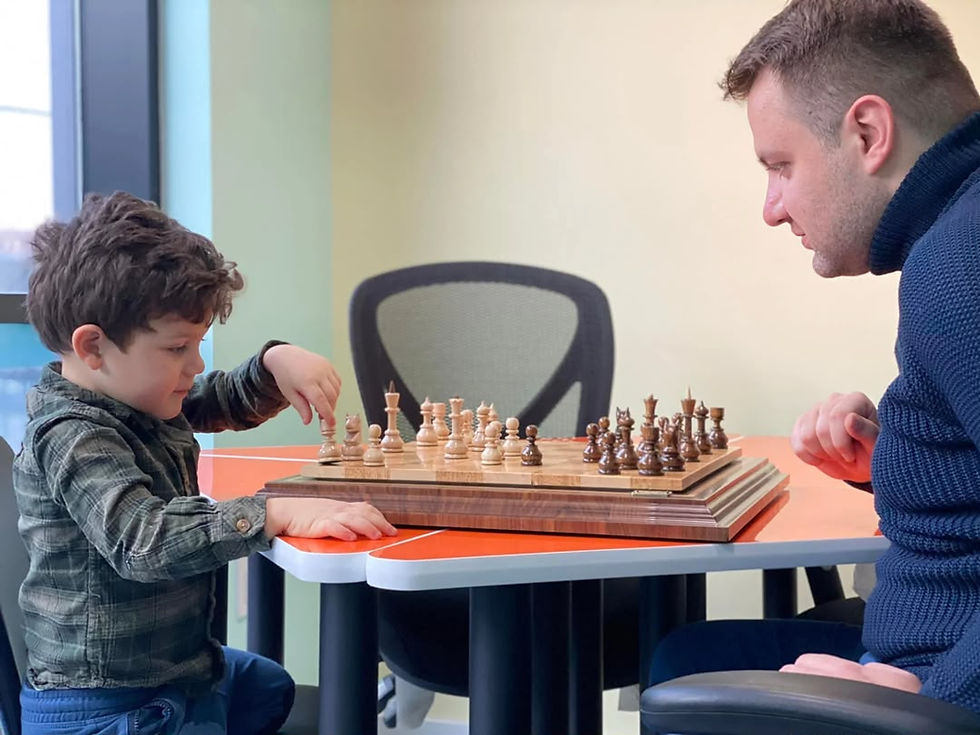
Let your child handle the pieces first. Name each one and tell its story: the King who must be protected, the Queen who is most powerful, the pawn soldiers. Children learn through narrative. Set up the board correctly together: white square bottom-right, Queen on her own color.
STEP 02 — Teach piece movements one at a time — not all at once
The biggest mistake: explaining all six pieces in one session. Teach one per session. Suggested order: King → Rook → Bishop → Queen → Knight → Pawn. The knight is the most counterintuitive — save it for last. En passant can wait until much later.
STEP 03 — Play capture mini-games before full games
Scatter pawns, give the child a rook, and ask them to capture all pawns as quickly as possible. For knight movement, use ChessKid.com or Lichess Learn — animated exercises are far more effective than verbal explanation.
STEP 04 — Introduce check and checkmate — the goal
Once all pieces are understood, introduce check and checkmate using simple setups (King + Queen vs. lone King). Don't explain stalemate, castling, or en passant yet. Save special rules for when they arise naturally in play.
STEP 05 — Play real games — with intentional mistakes
Make visible, genuine mistakes. Leave pieces hanging. Let your child discover they can take your Queen. A child who finds a tactic themselves remembers it permanently. Don't let them win by not trying — they sense it, and it teaches nothing.
STEP 06 — Introduce three opening principles — not specific openings
(1) Control the center. (2) Develop your pieces. (3) Castle to protect your King. These three ideas guide opening play for years without requiring memorized theory. Don't teach your personal opening — theory is for later.
STEP 07 — Introduce basic tactics — forks, pins, skewers
Best tool: ChessKid.com puzzle trainer or Lichess puzzles — both calibrate difficulty automatically. Assign 10 puzzles per day as homework. This is exactly what MM Chess coaches assign between sessions.
STEP 08 — Enter the first tournament — when ready, not when perfect
Ready means: knows all rules, can play a full game independently, enjoys chess. First tournaments teach more in one day than weeks of casual play. Find local events at US Chess Federation. For online: MM Chess runs free monthly tournaments for all active
students — a perfect first competitive experience.

Best Free Resources
ChessKid.com — gold standard for ages 5–12. Child-safe, animated lessons and puzzle trainer.
Lichess.org Learn — 100% free, excellent for ages 10+. Built-in lessons, puzzles, and game analysis.
US Chess Federation — tournament finder, ratings, scholastic resources.
MM Chess Blog — research-backed guides for parents on benefits, ADHD, and coaching.
When to Bring in a Coach
Parent-taught chess has natural limits. Signs it's time for professional coaching:
Your child has played 20+ games and asks strategic questions you can't answer
They're interested in tournaments and want to understand opening theory
They've developed habits you suspect are wrong but aren't sure how to correct
They've plateaued — the same types of mistakes appear in every game
They've expressed a desire to 'get better' at chess specifically
A FIDE-titled coach with a structured curriculum will produce in two months what casual parent-led play takes a year to develop. The Chess Steps Method used by MM Chess Academy builds on whatever foundation the child already has.
"My parents found a great coach through online chess forums. Thanks to his lessons and tutoring, I became a master — and I learned firsthand the power of structured online chess instruction."
Frequently Asked Questions
1. What age can a child start learning chess?
Most children are ready between ages 5 and 7. MM Chess Academy teaches from age 5.
2. How long does it take a child to learn chess?
Rules: 2–3 sessions. Basic tactical ability: 2–3 months of consistent play. Competitive skill grows continuously with practice and good instruction.
3. What if I don't know chess myself?
Use ChessKid.com to learn alongside your child. Once basics are in place, a $9.99 trial lesson gives you a clear picture of where to go next.
4. Should I let my child win?
No — make intentional, visible mistakes and let them find the wins. A child who discovers a tactic themselves learns chess. A child who wins because you moved randomly learns nothing.
5. When is my child ready for a coach?
When they can play a full game independently and are asking questions you can't answer. MM Chess Academy's $9.99 trial lesson includes a full skill assessment and personalized learning roadmap.
Ready to Go Further Than Parent-Taught Chess?
New students receive $60 off first month · Credits never expire · No contracts


Comments