Can Chess Help Kids with ADHD?

A growing body of peer-reviewed research confirms what many parents and educators have observed: structured chess instruction is one of the most effective non-pharmacological tools available for improving focus, impulse control, and self-regulation in children with ADHD.
This guide explains what the research shows, why chess works neurologically for ADHD brains, and how MM Chess Academy — with a FIDE Master who holds a psychology credential — is uniquely positioned to help. Can chess help kids with ADHD? Research suggests that structured chess lessons can improve attention span, impulse control, working memory, and emotional regulation. While chess is not a replacement for medical treatment, studies show it can be an effective complementary activity for many children.
What the Research Actually Shows
A 2023 systematic review in MDPI examined 12 studies on chess and ADHD and concluded chess therapy is 'effective in the management of ADHD patients in terms of reducing symptoms and severity.' Chess improved concentration, reduced impulsivity, and extended the duration children could stay on task.
A study on ADHD students aged 11–13 found chess significantly extended focus periods. Authors concluded it is 'relevant for ADHD children to train in chess as it helps them maintain focus longer and stay engaged.'
A clinical trial at ClinicalTrials.gov is currently testing chess as a 6-week add-on intervention for adolescents with psychiatric disorders including ADHD — testing improvements in cognitive functioning and quality of life.
"Chess therapy is effective in the management of ADHD — reducing symptoms and severity. Due to its effectiveness, playful nature, high adherence, and low cost, it can be used as a therapeutic tool in multimodal management."

Why Can Chess Help Kids with ADHD? Understanding the Brain
Impulse control — the touch-move rule
In chess, a player who touches a piece must move it. This structural demand for impulse control — with immediate, natural consequences — is unlike most classroom activities. A child with ADHD learns to think before acting through the game itself, not through adult instruction.
Sustained attention — every move matters
A lapse in attention has an immediate, concrete cost in chess: a piece is missed, a game is lost. This feedback loop creates a compelling attention-training environment where focus is a survival requirement, not just a request.
Working memory — holding the board in mind
Chess requires holding the current position, anticipating responses, and maintaining a plan simultaneously. This working memory workout directly targets the executive function most impaired by ADHD.
Emotional regulation — winning and losing
Every chess game ends clearly. For children with ADHD, who often struggle with frustration tolerance, learning to handle both outcomes in a structured, supportive environment builds emotional skills that generalize to daily life.
What Kind of Chess Instruction Works Best for ADHD
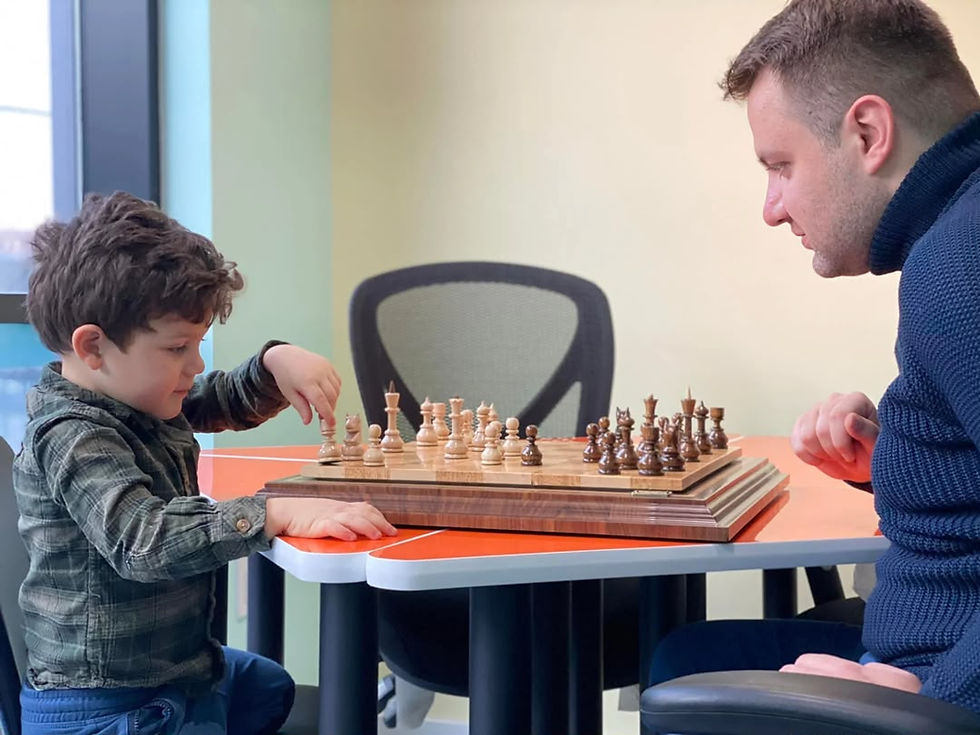
1-on-1 over group classes — group classes can be overstimulating; 1-on-1 provides a controlled environment
A patient, emotionally intelligent coach — ADHD children need a coach who responds with curiosity, not criticism
Short, focused sessions with clear goals — achievable milestones so the child finishes feeling successful
Consistent weekly routine — predictability is particularly effective for ADHD brains
Calibrated homework — puzzle sets must be manageable without causing frustration
MM Chess Academy's psychology-trained FIDE Master specializes specifically in working with children who have attention and emotional regulation challenges.
Getting Started: What to Expect
The first sessions focus on establishing routine more than teaching chess. By week four, most ADHD children in structured 1-on-1 coaching show measurable improvement in pausing before moving, considering alternatives, and sitting with uncertainty. MM Chess monthly tournaments add further structured competitive exposure.

Frequently Asked Questions
1. Can chess really help a child with ADHD?
Yes. A 2023 MDPI review of 12 studies found chess effective in reducing ADHD symptoms — improving concentration, reducing impulsivity. Recommended as part of a multimodal treatment approach.
2. Can chess replace ADHD medication?
No. Chess is a complement to existing treatment, not a replacement. Always work with your child's doctor when making changes to their treatment plan.
3. What type of class is best for an ADHD child?
1-on-1 coaching with a patient, emotionally intelligent instructor. MM Chess has a FIDE Master with a psychology credential who specializes in this.
4. How quickly will I see results?
Most parents notice changes in focused behavior within 3 to 4 weeks. Generalization to other settings tends to appear over a full school semester with consistent practice.
5. Does my child need to be good at chess for it to help?
No. Cognitive benefits emerge from the process of learning and playing, not from achieving a high rating. Start with a $9.99 trial lesson.
Give Your Child the Focus Advantage


Comments