Group vs. Private Chess Lessons: Which Is Right for Your Child?

Choosing between group and private chess lessons is one of the first decisions parents face. Both can work well. The right choice depends on your child's age, personality, goals and your budget, not on which option sounds more impressive.
This guide compares group vs private chess lessons in plain terms. You will see the pros and cons of each, how to match your child to a format, and the questions to ask before you pay.
Quick answer: Group lessons usually cost less per session and add friends and practice games, so they suit beginners and social kids. Private lessons cost more but give your child the coach's full attention and a plan built for them, so they suit kids who want faster progress, are preparing for tournaments, or learn better one-to-one. Many families start with group lessons and add private lessons later.
Group vs Private Chess Lessons: The Short Comparison
| Group lessons | Private lessons |
Cost per session | Usually lower | Usually higher |
Attention from the coach | Shared with the group | All on your child |
Pace | Set by the group | Set by your child |
Plan | Same curriculum for everyone | Built around your child's games and mistakes |
Social side | Friends, practice games, team feel | One-to-one, quieter |
Schedule | Fixed class times | Often more flexible |
Best for | Beginners, social kids, tighter budgets | Faster progress, tournament goals, shy kids |
Watch out for | Large classes, no feedback | Cost, and pressure on a child who is not ready |

What Are Group Chess Lessons?
In a group lesson, one coach teaches several children at the same time. Lessons are usually weekly and follow a set curriculum, with a mix of teaching, puzzles and practice games between students.
Pros of Group Chess Lessons
Lower cost. The coach's time is shared, so each family pays less per session.
Friends and practice partners. Kids play real games against each other, which builds confidence.
Structure. A set curriculum and a regular weekly time make it easy to build a habit.
Fun. Many children enjoy learning alongside others.
Cons of Group Chess Lessons
Less individual attention. The coach cannot stop to fix every child's mistakes.
Pace is set by the group. A fast learner may get bored, and a slower learner may feel rushed.
Quality depends on class size and level matching. A large mixed-level class helps few children.
Group Lessons Are Best For
Beginners, children who enjoy playing with others, and families who want a lower-cost start.
What Are Private Chess Lessons?
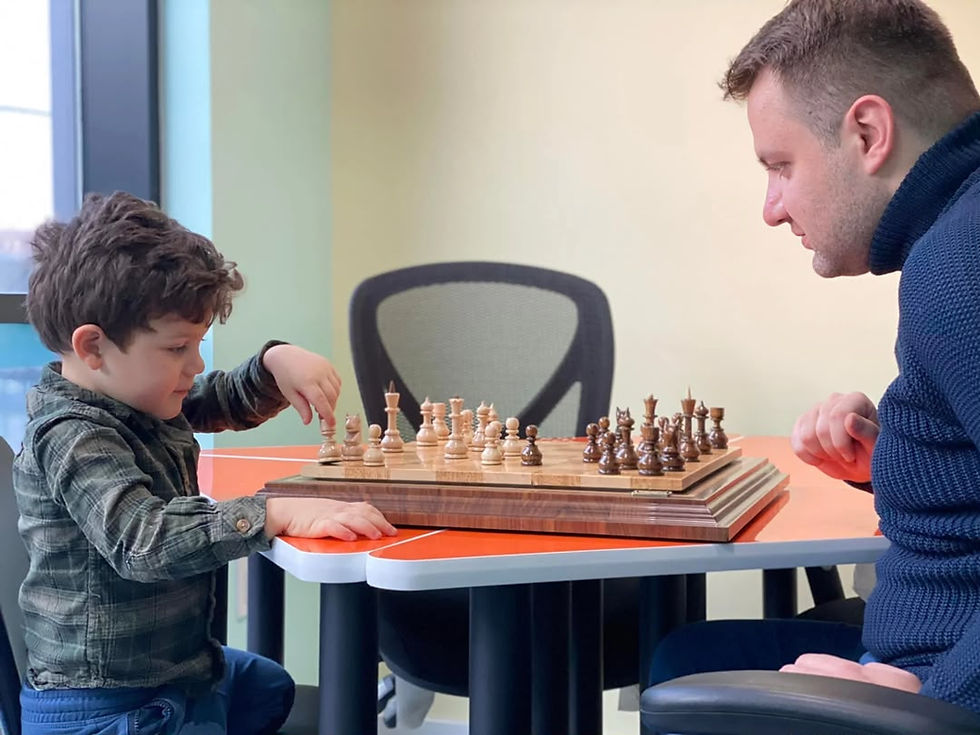
In a private lesson, the coach works with your child alone. The coach can look at your child's own games, find the habits behind repeated mistakes, and teach exactly what comes next.
Pros of Private Chess Lessons
Full attention. Every minute is spent on your child.
A personal plan. Lessons follow your child's level, style and goals.
Faster feedback. Mistakes are caught and fixed the same day.
Flexibility. Scheduling is often easier, and the lesson length can match your child's age.
Cons of Private Chess Lessons
Higher cost per session. You are paying for the coach's whole time.
Less peer play. Your child does not get regular games against classmates unless you add them.
More pressure for some children. A very shy or very young child may find one-to-one lessons intense at first.
Private Lessons Are Best For
Children who want faster progress, are preparing for tournaments, are shy in groups, or have hit a plateau. If you are unsure whether the extra cost is worth it, read our guide on whether a personal chess coach is really worth it.
How to Choose Between Group and Private Chess Lessons for Your Child

Think about five things, in this order.
1. Your Child's Age and Starting Level
Brand-new beginners often do well in a group, where the pace is gentle and the games are fun. Very young children can also do well in a short private lesson, since a coach can adjust to their attention span. If you are not sure your child is ready for either, see how to know if your child is ready for chess lessons.
2. Your Child's Personality
A social, talkative child often thrives in a group. A quiet or anxious child may learn more in a private lesson, where there is no audience. Watch how your child behaves in other classes, such as swimming or music, and use that as a clue.
3. Your Goals
If the goal is fun, friends and a good hobby, group lessons are usually enough. If the goal is tournament play, a rating or faster improvement, private lessons add a lot. Be honest about the goal, because it should drive the budget.
4. Your Budget and Schedule
Group lessons cost less per session but run at fixed times. Private lessons cost more but are usually easier to fit around school and activities. Our post on what chess lessons cost explains how prices work.
5. Your Child's Progress So Far
If your child is stuck, keeps repeating the same mistakes, or is far ahead of the class, it may be time for private coaching. Our guide on how to know when structured coaching is the missing piece covers the signs.
Can You Combine Group and Private Chess Lessons?
Yes, and many families do. A weekly group class gives your child friends and practice games. An occasional private lesson fixes the specific problems the group cannot address.
Good signs that it is time to add private lessons:
Your child finishes the group material quickly and looks bored.
Their rating or results have stopped improving.
They are preparing for a tournament and need a plan.
They are shy in the group and rarely ask questions.
For a realistic picture of what progress looks like in the first months, see what your child really learns in their first six months of structured chess.
What to Ask Before You Sign Up
For a Group Class
How many children are in the class, and how are levels matched?
Does the coach give each child feedback during the lesson?
Is there homework or a review of children's games?
Can my child try a trial class first?
For Private Lessons
Who is the coach, and can I verify their rating or title? You can look up players in the US Chess player search.
What will my child learn in the first three months?
Can I watch the trial lesson?
What are the cancellation and make-up terms?
For a full list, use our checklist on how to vet an online chess coach.
Online vs In-Person Group and Private Lessons
Both formats work online, and private lessons are often the easier one to run well. In an online group, check that the class is small enough for the coach to see each child's board and give feedback. For private online lessons, ask whether parents can sit in. US Chess publishes a Safe Play policy for its tournaments, but it does not cover private lessons, so safety checks are yours to make. Our online chess lessons guide explains how online lessons work.
How Lessons at MM Chess Work
At MM Chess, our lessons are private, one-to-one online lessons with a Master-titled coach. We offer 45-minute lessons, which suit small children and complete beginners, and one-hour lessons for students who are ready for more.
If you are still deciding, a trial lesson is the easiest way to see how your child responds to one-to-one coaching. You can look at our lesson plans to see the options.
Frequently Asked Questions About Group vs Private Chess Lessons
Which is better for beginners, group or private chess lessons?
Both work. Group lessons are often a good start for beginners who enjoy playing with other kids and want a lower cost. Private lessons suit beginners who are shy, very young, or who learn better with one-to-one attention.
Are private chess lessons worth the extra cost?
They can be, if your child is motivated and you want faster, more personal feedback. A coach can review your child's own games and build a plan around their mistakes. If your child mainly wants to have fun and meet other players, a group class may give you more value.
How big should a chess group class be?
Smaller is better, because each child gets more of the coach's attention. There is no standard size, so ask the provider for the exact number and how the coach gives feedback to each student.
Can my child switch from group to private lessons?
Yes. Many families start with a group class and move to private lessons when the child wants faster progress or is preparing for tournaments. Ask the provider whether they allow switching and how it affects the cost.
Can a child do both group and private lessons?
Yes. A common approach is a weekly group class for practice and social play, plus occasional private lessons to work on specific weaknesses.
What age should a child start chess lessons?
There is no single right age. A child is usually ready when they can sit for a short lesson and follow simple rules. Younger children often do better with shorter lessons.
Are online group chess classes effective?
They can be, if the class is small, the coach gives each child feedback, and the class is matched to your child's level. Large online groups where children mostly watch are less effective.
How often should my child have chess lessons?
Once a week is a common and sustainable pace for most children. What matters most is steady practice between lessons, not the number of lessons.
Do private lessons make a child's rating improve faster?
Often they can, because the coach focuses on that child's specific weaknesses. Progress still depends on how much the child practices and plays between lessons.
How do I know if a group class is not working?
Warning signs include your child feeling lost or bored, never getting individual feedback, no homework or review of games, and no clear progress after a few months. If you see these, talk to the coach, and consider a private lesson or a different class.
Conclusion
Group and private chess lessons are both good options. Group lessons give your child friends, practice games and a lower cost. Private lessons give your child the coach's full attention and faster, more personal feedback. Match the format to your child's age, personality, goals and budget, and remember that you can change later.
If you would like to see one-to-one coaching in action, book a trial lesson with MM Chess


Comments