Chess Homeschool Curriculum: Complete Guide for Homeschool Families

Updated: Aug 21
Homeschool families have always understood something traditional classrooms are only catching up to: the best education isn't just about what a child learns, but how they learn to think. Chess is one of the most powerful thinking tools available to any homeschool curriculum — not as a bonus activity, but as a core enrichment subject that builds the cognitive infrastructure everything else depends on.
This guide covers the curriculum structure, the teaching sequence, the best free resources, and exactly where MM Chess Academy's FIDE Master coaches fit in as the professional coaching layer most homeschool chess programs eventually need.
Key Research Statistics
Math effect size: 0.382 from 24-study meta-analysis of chess instruction (Sala & Gobet)
Reading effect size: 0.248 — same 24-study meta-analysis
25–30 hours of instruction per year = minimum threshold for meaningful benefits (NIH/PMC)
6 weeks to first tournament wins for students using structured homeschool chess curriculum
30+ countries use the Chess Steps Method in national curriculum
1. Why Chess Belongs in Every Homeschool Curriculum

A meta-analysis of 24 studies found chess instruction produces measurable improvements in mathematics (0.382) and reading comprehension (0.248). A 2025 Frontiers in Psychology study found young children who learned chess showed longer concentration in math and reading tasks. The Home Educators Association of Virginia notes chess builds confidence, responsibility, problem-solving, patience, and strategy — all in one game.
Chess homeschool benefits:
🧠 Critical Thinking — Every move demands assessment, option generation, and consequence evaluation — building deliberate thinking as a lifelong habit
📐 Math & Logic — Chess activates the same brain regions as mathematical reasoning: pattern recognition, spatial processing, logical sequencing
📚 Reading Comprehension — Chess trains cause-and-effect reasoning and holding multiple threads — skills that transfer directly to reading
🎯 Focus & Attention — Chess demands sustained concentration where lapses have immediate, concrete consequences
💪 Emotional Resilience — Analyzing losses rather than catastrophizing builds the growth mindset every homeschool parent works to develop
🤝 Social Skills — Sportsmanship, grace under pressure, and respectful competition taught through direct, immediate consequences
Further reading: 10 Proven Benefits of Chess for Kids — Backed by Science
2. How to Structure a Chess Homeschool Curriculum
The biggest mistake homeschool parents make with chess is treating it like free play. The research consistently shows that structured instruction produces cognitive benefits; casual play alone does not accumulate the same gains.
A strong chess homeschool curriculum has four components: a teaching sequence, a practice routine, a competitive outlet, and a progression system.
The Chess Steps Method — the gold standard
The Chess Steps Method is the most widely validated structured chess curriculum in the world, used by national federations in 30+ countries. It structures learning from complete beginner through approximately 1200 Elo in progressive steps. MM Chess Academy uses the Chess Steps Method as the backbone of every 1-on-1 coaching session. Workbooks are available parent-led from stappenmethode.nl.
ChessKid's free homeschool curriculum
ChessKid.com offers a free DIY curriculum guide specifically for homeschool families — the world's first free, vertically aligned chess curriculum. One homeschool co-op coordinator reported: kids were winning trophies in beginner tournament sections within six weeks of using it.
3. Step-by-Step Teaching Sequence for Homeschool Chess
STEP 01 — Weeks 1–2 — The board, the pieces, and the story
Introduce pieces as characters before teaching any rules. The King who must be protected. The Queen who rules the board. Use ChessKid.com's animated Learn section. Set up the board correctly together: white square bottom-right, Queen on her own color. Make it a daily habit.
STEP 02 — Weeks 3–5 — Piece movements — one at a time
Teach one piece per session in this order: King → Rook → Bishop → Queen → Knight → Pawn. The knight is last — most counterintuitive. Use 'capture mini-games' between pieces. Lichess's Learn section has excellent animated exercises for each piece, including knight movement.
STEP 03 — Weeks 6–7 — Check, checkmate, and the goal of the game
Introduce check and checkmate using simple setups: King + Queen vs. lone King. Practice from different positions. Don't introduce stalemate, castling, or en passant yet — save special rules for when they arise naturally.
STEP 04 — Weeks 8–10 — First full games — with intentional parent mistakes
Make intentional, visible mistakes. Leave pieces where your child can take them. React genuinely to their good moves. A child who discovers they can take your Queen learns chess permanently. A child who wins because you moved randomly learns nothing.
STEP 05 — Weeks 11–14 — Three opening principles
(1) Control the center. (2) Develop your pieces. (3) Castle to protect your King. These three ideas guide opening play for years without memorization. Don't teach your personal opening repertoire — opening theory is for students who already understand positional chess.
STEP 06 — Week 15 onwards — Tactics — the fastest path to improvement
Introduce forks (one piece attacks two), pins (piece frozen because moving exposes more valuable piece behind), and skewers. Daily puzzle practice: 10 puzzles on ChessKid puzzles (ages 5–12) or Lichess puzzle trainer (800,000+ puzzles, free, auto-calibrated). This 15-minute daily habit is where most improvement happens.
4. Sample Weekly Chess Homeschool Schedule
The research threshold: 25–30 hours/year = 30–45 minutes/week. Here's a realistic homeschool schedule:
Day | Activity | Duration | Resource |
Monday | New concept lesson | 20–30 min | ChessKid Learn or Chess Steps workbook |
Tuesday | Puzzle practice | 15 min | Lichess puzzles or ChessKid puzzles |
Wednesday | Practice game | 20–30 min | Physical board or Lichess |
Thursday | Puzzle practice | 15 min | Lichess or ChessKid |
Friday | Game review or free play | 20 min | Review Monday's concepts |
Monthly | Online tournament | 1–2 hrs | MM Chess free monthly tournament or USCF event |
For families using MM Chess Academy 1-on-1 coaching, the Monday lesson becomes the weekly coaching session — and the coach assigns homework for the rest of the week. This turns the above schedule into a complete, coach-directed program with no curriculum planning required from the parent.
\
5. Best Free Resources for Homeschool Chess
ChessKid.com Homeschool Curriculum — Free DIY guide for homeschool families. Animated lessons, puzzle trainer, child-safe. Best for ages 5–12.
Lichess Learn & Puzzles — 100% free, no ads. Structured lessons + 800,000+ puzzles. MM Chess coaches use Lichess for all shared-board sessions.
Chess.com Free Curriculum — Vertically aligned, usable by parents with no chess background.
Chess Steps Method workbooks — International structured curriculum, parent-led versions available.
US Chess Federation — Tournament finder by state and age group. Register for USCF rating.
HSLDA.org — State homeschool requirements, co-op directory, documentation guidance.
6. When to Bring in a Chess Coach for Your Homeschool Student
Parent-taught chess has real limits. Signs it's time for professional coaching:
Your child has played 20+ games and asks strategic questions you can't confidently answer
They've developed habits you suspect are wrong but aren't sure how to correct
They've plateaued — the same mistakes appear in game after game without improvement
They're interested in rated competition and want to understand opening theory
You want a structured curriculum but don't have the time or background to deliver it yourself
A FIDE-titled coach with a structured curriculum will produce in two months what parent-led play would take a year to develop. MM Chess Academy's $9.99 trial lesson includes a full skill assessment and personalized learning roadmap — no guesswork, no wasted sessions.
“When I was younger, the internet became just good enough to begin taking online lessons. We didn’t love our options in Columbus, Ohio, so my parents turned to a few chess forums online and found a great Russian-language coach in Serbia. Thanks to his lessons and tutoring, I became a master — and I learned firsthand the power of structured online chess instruction.”

MM Chess Academy for Homeschool Families — What You Get
● 1-on-1 live coaching from a FIDE Master or Grandmaster — every session personalized, no group format
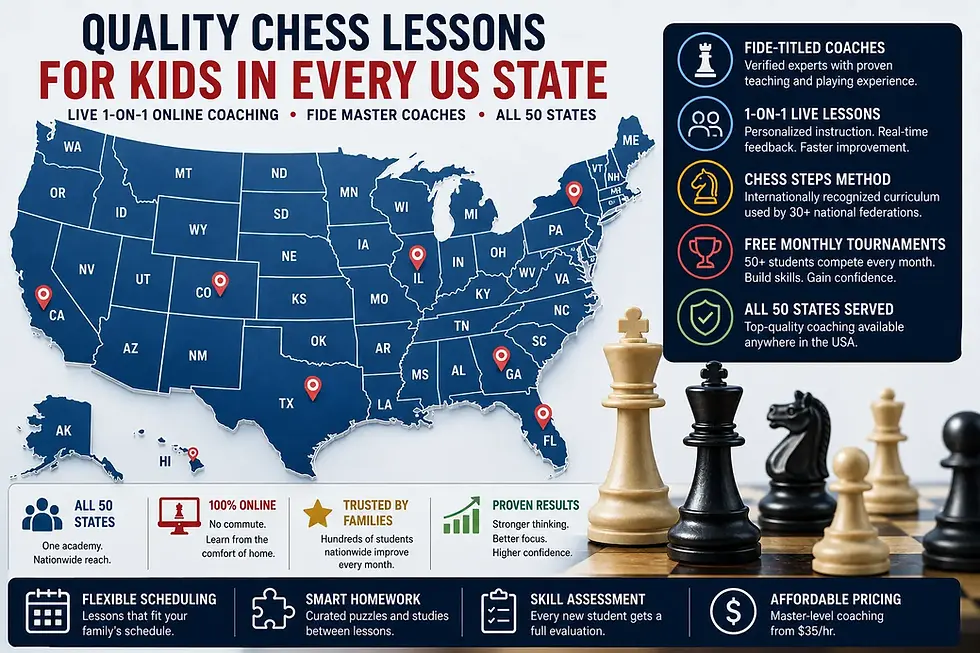
● Chess Steps Method curriculum — 30+ national federations, adapted to your child's starting point
● Weekly homework assignments — puzzle sets calibrated to your child's level, filling the rest of the chess week
● Free monthly tournaments — 50+ students competing monthly, guided online environment
● No commute, no schedule conflict — fits any homeschool timetable, anywhere in the USA
7. Homeschool Chess Tournaments, Co-ops & Competitive Play
Online tournaments for homeschoolers
MM Chess Academy's free monthly online tournaments — open to all active students. 50+ children at similar rating levels, Misha Vilenchuk present live. The most common first competitive experience for MM Chess homeschool students, included at no cost.
USCF-rated tournaments
USCF tournament finder — all rated scholastic and open tournaments by state and age group. Homeschool students compete on equal footing with school students. Registering for a USCF rating is free with the first tournament entry.
Homeschool chess co-ops and networks
Many homeschool networks run dedicated chess co-ops. The North Carolinians for Home Education Chess Network is one established example — running tournaments specifically for homeschool families. Search your local homeschool association or HSLDA's co-op directory for co-ops in your area.
Illinois and Chicago homeschool chess
MM Chess Academy's 20+ Chicago school partnerships and the Chicago Chess Center's weekly rated events together create a complete in-person and online chess program for Chicago-area homeschool families.
8. Frequently Asked Questions
1. Can chess be part of a homeschool curriculum?
Yes. Chess improves math (0.382 effect), reading (0.248), working memory, and attention — all aligning with homeschool academic goals. 24-study meta-analysis.
2. What is the best chess curriculum for homeschoolers?
Structured: Chess Steps Method (30+ national federations, taught by MM Chess coaches). Free self-directed: ChessKid free homeschool curriculum.
3. How do I teach chess if I don't know chess?
Start with ChessKid.com — learn alongside your child. Once basics are established, MM Chess Academy's $9.99 trial lesson provides a skill assessment and a FIDE Master takes over instruction.
4. How many hours per week should homeschool chess take?
25–30 hours/year (NIH research) = 30–45 minutes/week. One weekly lesson (45–60 min) plus 10–15 minutes daily puzzles on Lichess or ChessKid is ideal.
5. Are there homeschool chess co-ops or clubs?
Yes — search your local homeschool association or HSLDA directory. USCF tournament finder lists rated events open to homeschoolers. MM Chess monthly tournaments are free for all active students.
6. Does chess count as a school subject for homeschoolers?
In most US states, chess counts toward physical education, critical thinking, or enrichment credits. Check state-specific requirements at HSLDA.org.
7. What age should homeschool students start chess?
MM Chess Academy teaches homeschool students from age 5. Most children are ready between 5 and 7. Age matters less than the quality and consistency of instruction.
8. How do I find chess tournaments for my homeschool student?
USCF tournament finder — filter by state and age group. MM Chess monthly online tournaments — free for all active students, most common first competitive experience for homeschool students.
Add a World-Class Chess Coach to Your Homeschool Program
Start with a 1-hour trial lesson — full skill assessment and personalized learning roadmap included. FIDE Master coaches, Chess Steps Method curriculum, homework between every session. Fits any homeschool schedule, anywhere in the USA.


Comments